
What New Bankruptcy Law Means for Small Businesses

Small businesses often struggle to reorganize effectively under Chapter 11 of the Bankruptcy Code in the past. This was largely due oo To address this issue, Congress passed the Small Business Reorganization Act of 2019, creating a new subchapter of Chapter 11 of the Bankruptcy Code. The Act takes effect in February 2020. Businesses, lenders and other creditors should understand the risks and opportunities created by this new subchapter of the Bankruptcy Code.

The Act aims to make small business bankruptcies faster and less expensive. At this time, the Act only applies to business debtors with secured and unsecured debts, subject to certain qualifications, less than $2,725,625. Our Los Angeles based experts are here to help you maximize including the po

Some notable provisions of the Act include:

  • Appointment of a Trustee. The Act provides for the appointment of a trustee who will help facilitate reorganization and may monitor payments to creditors under the debtor’s confirmed plan.
  • Streamlining of the Reorganization Process. Only the debtor can propose a plan of reorganization, and must submit its plan within 90 days of the bankruptcy filing. The court does not have to approve a separate disclosure statement, reducing the time and expense necessary to confirm the debtor’s plan. The Act does not provide for a committee of unsecured creditors, absent an order from the Court. Removing the creditors’ committee should further reduce costs associated with the bankruptcy.
  • Elimination of the Absolute Priority Rule. In a typical Chapter 11, the debtor must pay unsecured creditors in full if the business owners wish to retain their equity interests. The Act removes this requirement. This is a significant change from prior law. In most cases, particularly with closely-held businesses, the business owners want to keep their ownership interests. Under the Act, plan confirmation only requires that the plan does not discriminate unfairly, is fair and equitable, and provides that the debtor will contribute all of its projected disposable to the plan.
  • Modification of Certain Residential Mortgages. The Act also removes the categorical prohibition against individual small business debtors modifying their residential mortgages. A small business debtor may now modify a mortgage secured by a residence if the underlying loan was for commercial purposes.
  • Delayed Payment of Administrative Expense Claims. The Act removes the requirement that the debtor pay priority claims – including for goods and services provided to the debtor during bankruptcy – on the effective date of the plan. A small business debtor may now stretch payment of these claims out over the term of the plan, which will typically last about five years.
  • Discharge Limitations. The scope of the small business debtor’s discharge of debts will now depend upon the terms of the plan and the consent of creditors. If the creditors contest the plan, exceptions to a discharge, such as fraud and breach of fiduciary duty, will apply to the small business debtor. This is a departure from a typical business Chapter 11 that only has very limited exceptions to discharge.

The benefits of Chapter 11 reorganization have been elusive to small business debtors given their size and limited financial resources. The Act attempts to remedy these obstacles. If the Act proves successful, there may be a legislative push to increase the debt limit and provide more businesses access to the new subchapter.


Chapter 7 Bankruptcy Tips

Chapter 7 Bankruptcy: What to Avoid Before Filing

For a trouble-free Chapter 7 bankruptcy, avoid these transactions before filing.

If you’re considering bankruptcy, there are many things that you may innocently or accidentally do with your finances, which could hurt your bankruptcy case, even if you don’t plan to file for many months. It’s usually best to talk to a lawyer when planning for bankruptcy, but even before you do so, take care to avoid the below financial transactions. This will ensure that your bankruptcy filing goes smoothly and will help to avoid challenges by creditors or the trustee.

Don’t Transfer Money or Property

Many consumers think that transferring their assets to their mothers’ bank accounts, or putting them in their wive’s names, will protect them. But transferring assets out of your name won’t protect them from the reach of the bankruptcy court. And worse, such transfers could lead a bankruptcy court to find that you have committed fraud. This is true even if you transferred the property innocently, without any intention to conceal assets.

A few examples of transfers that might get you in trouble include:

  • changing title to a child’s or spouse’s car which is in your name, into the name of your child or spouse
  • changing the name on bank accounts, or eliminating your name from accounts which are held jointly with others
  • eliminating your name as an owner on business ventures
  • depositing funds or moving funds into bank accounts belonging to others, and
  • deeding real property in your name to another person, even if it’s a legitimate transaction where real value is paid.

Many consumers move property or funds out of their name, for fear of losing them in bankruptcy. However, having assets does not mean that you cannot file a bankruptcy nor that you will necessarily lose them. An attorney will be able to tell you the best way to deal with assets that you fear may be exposed when you file a bankruptcy.

Don’t Pay Creditors

Many consumers want to “do the right thing,” and pay certain creditors in full before filing for bankruptcy. For example, they may want to make sure mom’s loan gets paid, or that the people at Discover who have been very nice to them get paid in full. These transactions are prohibited.

You certainly can pay your bills as you would in the normal course of business. If you incur $100 on American Express this month, you can pay it off next month, as you ordinarily would. However, you cannot make a payment out of the ordinary, to satisfy a creditor in full. These payments are called preferential transfers. They may even lead to “claw back” lawsuits, where the bankruptcy court representative (called the bankruptcy trustee) sues the entity or person that you paid, to get the money back. (For more on how this works, see  Bankruptcy Clawbacks of Preferential and Fraudulent Transfers.)

Don’t Use Credit Cards

Unless you absolutely need to incur extra credit card debt for the necessities of life, such as gas, housing, or food, you should stop using your credit cards completely. You can continue to use debit cards which withdraw directly from your bank account.

Don’t Make Unusual Deposits Into Your Bank Account

Do not deposit any money which is not considered salary or payment to you, into your bank account. Examples would be depositing money in your account as a favor to others, or which is not your money. Consumers with small businesses also should refrain from conducting transactions for the business through their personal accounts.

Don’t Sue Anybody

Any legal claim that you have is an asset that can be taken by the bankruptcy court, even if the case is unresolved, or if the amount you may be entitled to is undetermined. In fact, even claims that you may have against others that have not been filed in court, is property of the bankruptcy estate. If you have a pending legal claim (whether it’s a lawsuit or not), talk to a lawyer before filing for bankruptcy.

Think Carefully Before Taking Actions That Would Result in Future Payments

Funds that are not actually in your possession, but which you expect to be get in the future, are part of your bankruptcy estate. If you are filing for Chapter 7 bankruptcy, the bankruptcy trustee can take this money and use it to repay your unsecured creditors. Examples include agreeing to accept a future bonus at work, accepting an inheritance which will be paid in the future, or filing tax returns that entitle you to a refund. If you are expecting to receive any payments or money in the future, talk to a bankruptcy attorney.

Waiting to File

Most of the above mistakes can be cured simply by waiting to file. There are “look back” periods for many types of transfers or actions — which means the bankruptcy court will examine certain types of transactions only within a certain period of time before you file. By delaying the filing of your bankruptcy until these periods have expired, you may be able to avoid problems.

When To Write Your Will

There are a few big life events that can happen to a person that can bring up the question “is it time I write my will?” This can sometimes happen after a medical diagnosis or when you have your first child. For everyone, deciding when to write your will is going to be different based on the individual’s experiences. Here are a few big life events where you should consider drafting up your will.

After The Wedding

Combining your family and assets is a perfect occasion to create a will. This will also have an affect on your beneficiaries. The same idea applies in situations of divorce as well.

Your First Child

This one is obvious. When drafting your will after having children, you are considering them first and foremost and what is important for you to leave behind. You will have more control of how to divide your assets and who you want to appoint as guardian. Once your child or children have reached legal age (or after your family has grown in numbers), it’s a good idea to revisit the will for any revisions you might want to make.

Medical Diagnosis

This can apply to you, a family member, or a friend. Witnessing tough medical diagnoses can have a big affect on how you see your future. Whether you personally are facing these experiences, or someone you know is facing a difficult time, this is a good time to consider creating your will.

Making Large Investments

Buying a house? Beach home? Rare collectibles? Whenever making a large investment, it’s a good idea to put some focus on the will, even if you are just adding assets.

It’s Just Time

No real excuse to write your will, but you’re still considering it? If you already have property and assets you want to protect, there’s no better time than now. Not much to your name? Maybe now isn’t the right time. Don’t overthink it. If you have any questions about Estate Planning, don’t hesitate to call us at 818-630-7280 for a free 30 minute consultation.

How To Stop Robocalls From Reaching Your Phone and Your Rights

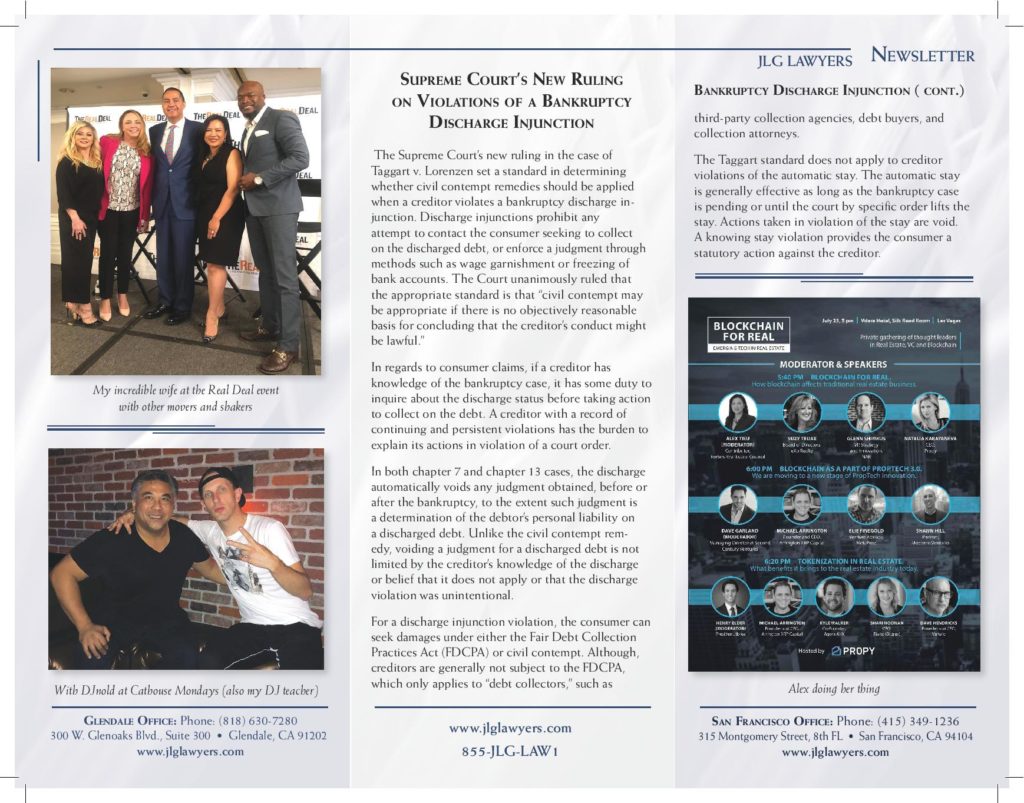
According to research done by the communications security firm First Orion, from 2017 to 2018, the amount of spam calls placed jumped from 3.7% to 29.2%. In 2019, it’s expected that almost half of all cell phone calls will be spam calls if this trend continues.

The first step you can take to minimize the amount of robocalls you receive is to put your number on the National Do Not Call Registry, which is maintained by the Federal Trade Commission. However, since there are many marketers who will ignore the registry, another way to filter these calls is to let an app screen your calls. Some apps that carriers offer for free include T-Mobile Scam Block, Sprint Premium Caller ID, Verizon Call Filter, and AT&T Call Protect. Additionally, there are third-party apps which are designed and widely used to smartly block spam calls such as YouMail, Truecaller, Hiya, and RoboKiller.

If a specific spam caller continues to reach you after taking these steps, the good news is you can easily block that number. However, if several robocalls continue to get through after taking these steps, you can take advantage of your iPhone’s “Do Not Disturb” feature. This will allow you to change your settings so that you are only notified of calls and texts from the contacts you choose, sending any unknown numbers directly to voicemail.

The Telephone Consumer Protection Act (TCPA) generally regulates advertising over the phone in-cluding robocalls and the sending of text messages. Unsolicited robocalls and text messages are harassing and annoying, and they can cost you by using your wireless-plan minutes or by having you incur other charges. The TCPA allows consumers subjected to prohibited conduct to file a lawsuit to recover statutory damage amounts of $500 to $1500 per violation.

If you believe you have received an illegal advertising call or text, please call us today at 818-630-7280 for a free consultation.

An Option to Reorganize and Save Your Business

If your company has faltered on the road to success, and debts have overtaken your ability to pay them, Chapter 11 Bankruptcy is an option to reorganize your business. Filing a Chapter 11 bankruptcy does not require closing your doors or selling the company to appease the debtors. Instead, it is a legal way to end collections harassment and come up with a plan for repayment of debts, capital improvements and future success. The question of whether to file a Chapter 11 bankruptcy usually comes down to having limited options.

Of course, other chapters of bankruptcies may be considered, but they frequently require downsizing, selling off assets, or closing up shop completely. If you want to hold on to your company and still believe that it can succeed over time, Chapter 11 gives you that opportunity. The majority of Chapter 11 bankruptcy cases are filed by business entities such as LLCs, and large corporations. Individuals are also eligible to file for Chapter 11 and it can be the best option for someone who is highly leveraged with valuable or cash flowing assets. In some cases, this is the only way to hold on to a company and remain solvent when income fails to meet expenses. JLG Lawyers delivers a professional and customized approach to your specific needs, depending on the situation at hand. If you believe that your company might benefit from a Chapter 11 bankruptcy, call our office at 818-630-7280 to schedule a free consultation with an attorney.

Legislation Updates Every Employer Should Know

Employment laws are constantly changing, and it’s important for employers to stay updated on new legislative requirements so they don’t unknowingly violate them. Under the new Senate Bill 1343 which will take effect January 1, 2021, employers with five or more employees (including temporary or seasonal), must provide at minimum two hours of sexual harassment training to supervisory employees and one hour of sexual harassment training to nonsupervisory employees.

Employers are mandated to provide this training within six months of hiring a new employee and once every two years thereafter. Additionally, a second bill was introduced to clarify that an employer who provided the required training and education to an employee in 2019 is not required to re-train that employee for another two years. Furthermore, there are two new requirements regarding the mandatory notices that must be posted in the workplace.

All employers covered by the California Family Rights Act (CFRA) and/or the New Parent Leave Act (NPLA) must post a notice explaining the Acts’ provisions and procedures. Employers with 20 to 49 employees must post new notices at their location, while employers with over 50 employees must update their existing notices. Lastly, this new regulation requires that employers updated their handbook to include a description of the CFRA and/or NPLA leave information by April 1, 2019. While these changes may seem minor, it is crucial that employers abide by these new regulations and make the necessary adjustments in order to avoid liability. If you or someone you know has an employment issue and is in need of legal assistance, please call our office at (818) 630-7280 to schedule a free consultation with an attorney

August 2019 Newsletter

This newsletter is dedicated to friendship.

I recently had the honor of standing for a close friend’s wedding. Our relationship has survived and thrived over two decades.

Skybar Pool Party

Annual Vegas Trip with childhood friends (aka brothers from another mother)

To be sure, lifetime friendships take a lot of work, commitment and sacrifice, but ultimately are worth more than any material possession. Thank you Michael Haworth, for yours.

“Today’s relationships give life meaning.”

– John Maxwell

July 2019 Newsletter

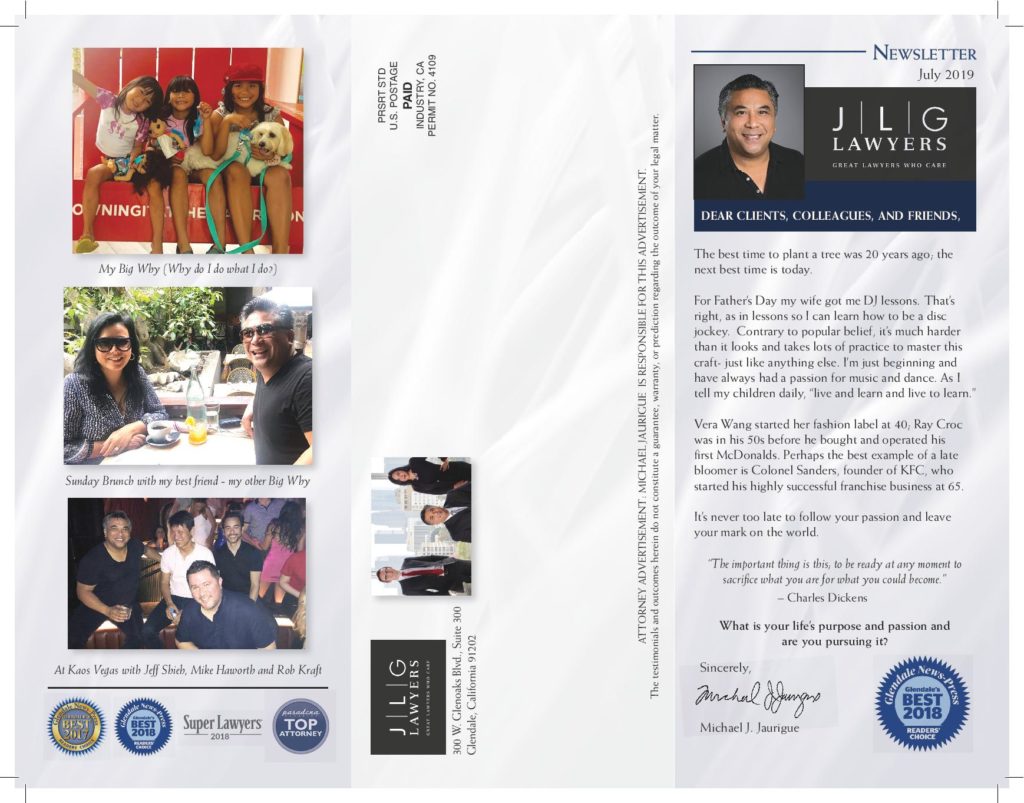
The best time to plant a tree was 20 years ago; the next best time is today.

For Father’s Day my wife got me DJ lessons. That’s right, as in lessons so I can learn how to be a disc jockey. Contrary to popular belief, it’s much harder than it looks and takes lots of practice to master this craft- just like anything else. I’m just beginning and have always had a passion for music and dance. As I tell my children daily, “live and learn and live to learn.”

Vera Wang started her fashion label at 40; Ray Croc was in his 50s before he bought and operated his first McDonalds. Perhaps the best example of a late bloomer is Colonel Sanders, founder of KFC, who started his highly successful franchise business at 65.

It’s never too late to follow your passion and leave your mark on the world.

“The important thing is this; to be ready at any moment to sacrifice what you are for what you could become.”

– Charles Dickens

What is your life’s purpose and passion and are you pursuing it?

June 2019 Newsletter

Every day to keep the right perspective, I ask myself what’s my Big Why? Why do I do what I do?
I imagine for most of us, the answer is the same:

I also write in my gratitude journal at least 10 things I’m thankful for. If you’ve lost perspective and are pondering your life’s purpose, this is a very helpful exercise and I strongly encourage you to try it.

“Give infinite love, joy and happiness.”

–Hung Phi Tieu (October 15, 1954 – September 21, 2013).

May 2019 Newsletter

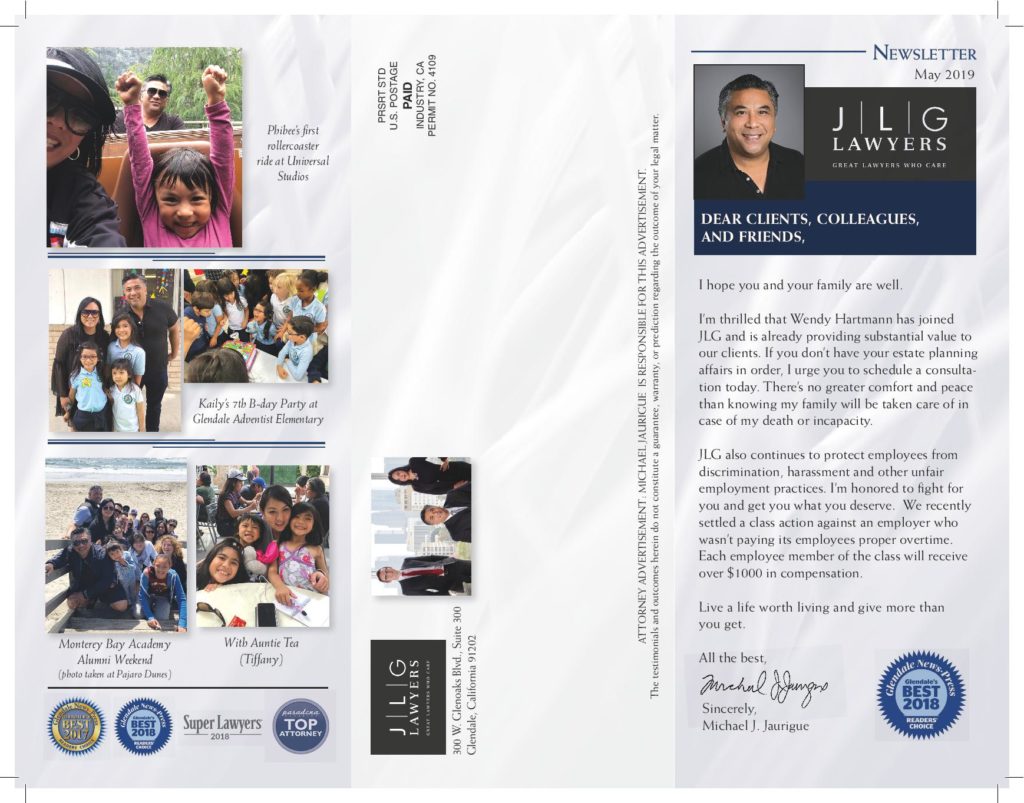
I hope you and your family are well.

I’m thrilled that Wendy Hartmann has joined JLG and is already providing substantial value to our clients. If you don’t have your estate planning affairs in order, I urge you to schedule a consultation today. There’s no greater comfort and peace than knowing my family will be taken care of in case of my death or incapacity.

JLG also continues to protect employees from discrimination, harassment and other unfair employment practices. I’m honored to fight for you and get you what you deserve. We recently settled a class action against an employer who wasn’t paying its employees proper overtime. Each employee member of the class will receive over $1000 in compensation.

Live a life worth living and give more than you get.